Diatomite drying mats: what they do and how to look after one

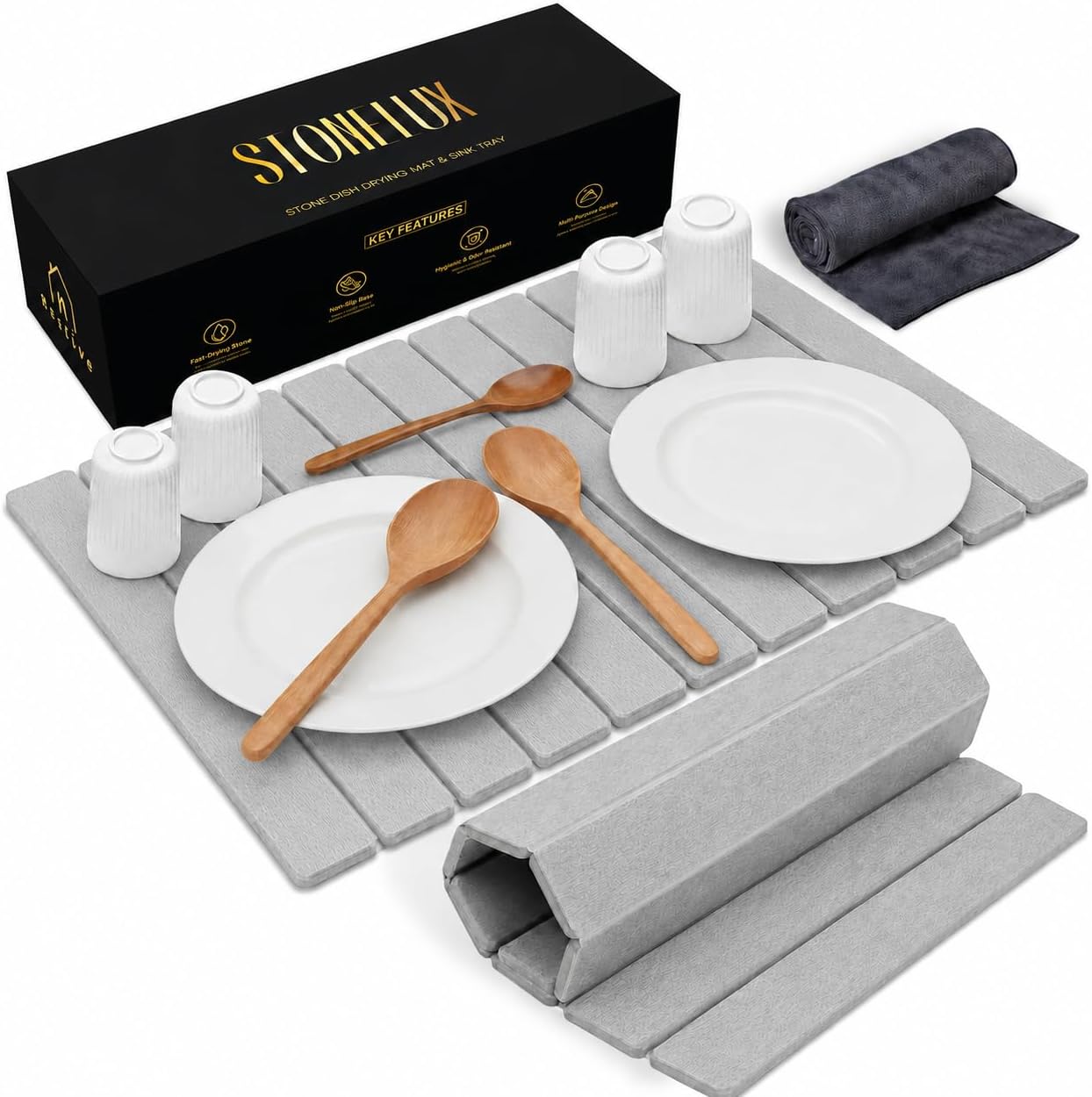
Stone drying mats look like an odd luxury next to a folded tea towel until you understand the mechanism. Diatomite is a highly porous mineral, and its structure moves water off the surface into the body of the mat where it evaporates. That is a different process from a cloth holding water, and it explains both the advantages and the maintenance.
It wicks rather than absorbs
Water landing on the surface is drawn into a network of tiny pores by capillary action and spreads through the mat, greatly increasing the surface area available for evaporation.
The visible result is a wet patch disappearing within a minute or two. The water has not gone anywhere except into the stone, where it is drying.
It cannot go sour, because it does not stay wet
A tea towel or cloth mat holds water in fibres for hours, which is what causes the smell. A stone mat is dry again quickly, so there is no sustained damp for anything to grow in.
This is the main practical advantage in a household, and it is why they are worth the higher price for a lot of people.
Restore it by sanding, not by washing
Over months the surface pores clog with soap residue and mineral scale, and absorption slows. Washing does not clear this because the blockage is in the pores.
Fine sandpaper over the surface removes the clogged layer and exposes fresh pores. Mats are usually supplied with a sheet for this, and a light pass every few months restores performance completely.
Let it dry fully between heavy uses
A saturated mat has no capacity left and water will sit on the surface. That is not a fault — it is a full sponge.
Standing it on edge occasionally, or leaving it uncovered overnight, restores capacity. In a busy kitchen having two and alternating them works well.
They are brittle, and they chip
Diatomite is a rigid mineral board. It resists water and heat well and does not tolerate being dropped on a hard floor.
Store it flat or standing securely rather than balanced against something. Most damaged mats were knocked over rather than worn out.
Do not use oil or soap on the surface
Anything that leaves a film blocks the pores, which is precisely the failure mode you are trying to avoid. Oily residue is particularly hard to clear.
Plain water for cleaning, and sandpaper for restoration. That is the entire maintenance regime.
Stone mats here
The diatomite mats and faucet strips on this shelf all work on this principle, in sizes for a counter, a sink edge or behind a tap. On our own shelf that range currently runs from $29.99 for the Nestive Stone Drying Mat for Kitchen Counter, Foldable Diatomite Dish Mat, 24×16 up to $29.99 for the Nestive Stone Drying Mat for Kitchen Counter, Foldable Diatomite Dish Mat, 24×16.
These belong to Dish Drying, a group of 1 product as it stands. What is listed is what is charged; delivery is shown on its own line, not folded in later.
Related reading
Two other pieces on this site cover ground next to this one. Stainless steel resists rust rather than being immune to it, and a caddy sitting in water is the hardest test you can give it. And on a related note, most US kitchen sinks share one drain size, which makes this one of the easier things to replace.
- Why sink caddies rust, and how to choose one that will not
- Fitting a three-and-a-half inch sink strainer
Mistakes that ruin a stone mat
Putting it in a dishwasher is the most damaging. The combination of detergent, prolonged saturation and heat drives residue deep into the pore structure, and a mat treated that way often never absorbs properly again.
Standing hot pans on one is the other. Diatomite handles warmth but it is a rigid mineral board, and thermal shock across a thin section is how they crack straight down the middle.
Choosing a size that actually helps
A mat smaller than the wet area it is meant to serve just moves the puddle to its edges. Measuring the space where things actually drain, rather than buying the standard size, is worth doing.
For a sink surround, a long narrow strip behind the tap often works better than a large rectangle on the counter, because it sits where the water actually collects rather than where there happens to be room.
Keeping one working
Use plain water only, let it dry out fully between heavy sessions, sand the surface lightly when absorption slows, and store it where it cannot be knocked over. Looked after that way a stone mat lasts for years and never smells.
We ship out of Los Angeles, CA for $5.50, or free above $45, and take unused returns for 30 days. [email protected] if you want to check something first.