Why sink caddies rust, and how to choose one that will not

A rusting sink caddy is a common complaint and an avoidable one. The explanation is that "stainless" describes a resistance, not an absolute, and that resistance depends on the steel being able to re-form its protective layer — which requires oxygen. A caddy sitting in standing water is being denied exactly that.
Stainless works by re-forming an oxide layer
The chromium in stainless steel reacts with oxygen to form a thin passive layer that protects the metal underneath. Scratch it and it reforms, provided oxygen is available.
Under a permanent film of stagnant water, particularly with detergent and salt in it, that process is inhibited and corrosion can begin.
Drainage is therefore the primary defence
A caddy that lets water run straight out is a caddy whose steel is exposed to air most of the time. One with a flat base and no holes holds a shallow pool indefinitely.
This is why self-draining designs last so much longer, and why it is worth prioritising over the finish or the shape.
Grade matters, and 304 is the useful benchmark
Grade 304 stainless contains enough chromium and nickel to handle a wet kitchen environment well. Cheaper 201 grade has less nickel and corrodes noticeably sooner in the same conditions.
Listings that state 304 are telling you something meaningful. Listings that just say "stainless steel" may be either.
Coated steel fails where the coating is broken
Powder-coated or painted caddies look good and protect well until the coating chips. Once bare steel is exposed at a chip, rust starts there and spreads underneath the coating.
They are a reasonable choice if handled gently, and a poor one if the caddy gets knocked about or scrubbed with anything abrasive.
Contact with other metals accelerates it
Leaving steel wool or a cast iron pan resting on a stainless caddy transfers iron particles onto the surface, and those particles rust and stain the caddy underneath.
It usually looks like the caddy has rusted when it has not. Removing the deposit and rinsing normally sorts it out.
Rinse it, because detergent residue is corrosive
Concentrated detergent and salt left drying on steel are more aggressive than plain water. A caddy that never gets rinsed accumulates exactly that residue in its corners.
A rinse when you finish washing up, and a proper clean occasionally, prevents it.
Caddies on this shelf
The rustproof lines here are the self-draining ones, and the listings name the grade where it is specified. On our own shelf that range currently runs from $6.29 for the 2 Pack Hilltop Products Kitchen Sink Strainer & Stopper for 3.5-inch Drains up to $14.99 for the Lyxel Fast Drying Diatomite Stone Faucet Mat for Kitchen Sink, Dark Gray 20" x 4".
These belong to Sink Accessories, a group of 7 products as it stands. What is listed is what is charged; delivery is shown on its own line, not folded in later.
- 2 Pack Hilltop Products Kitchen Sink Strainer & Stopper for 3.5-inch Drains — $6.29
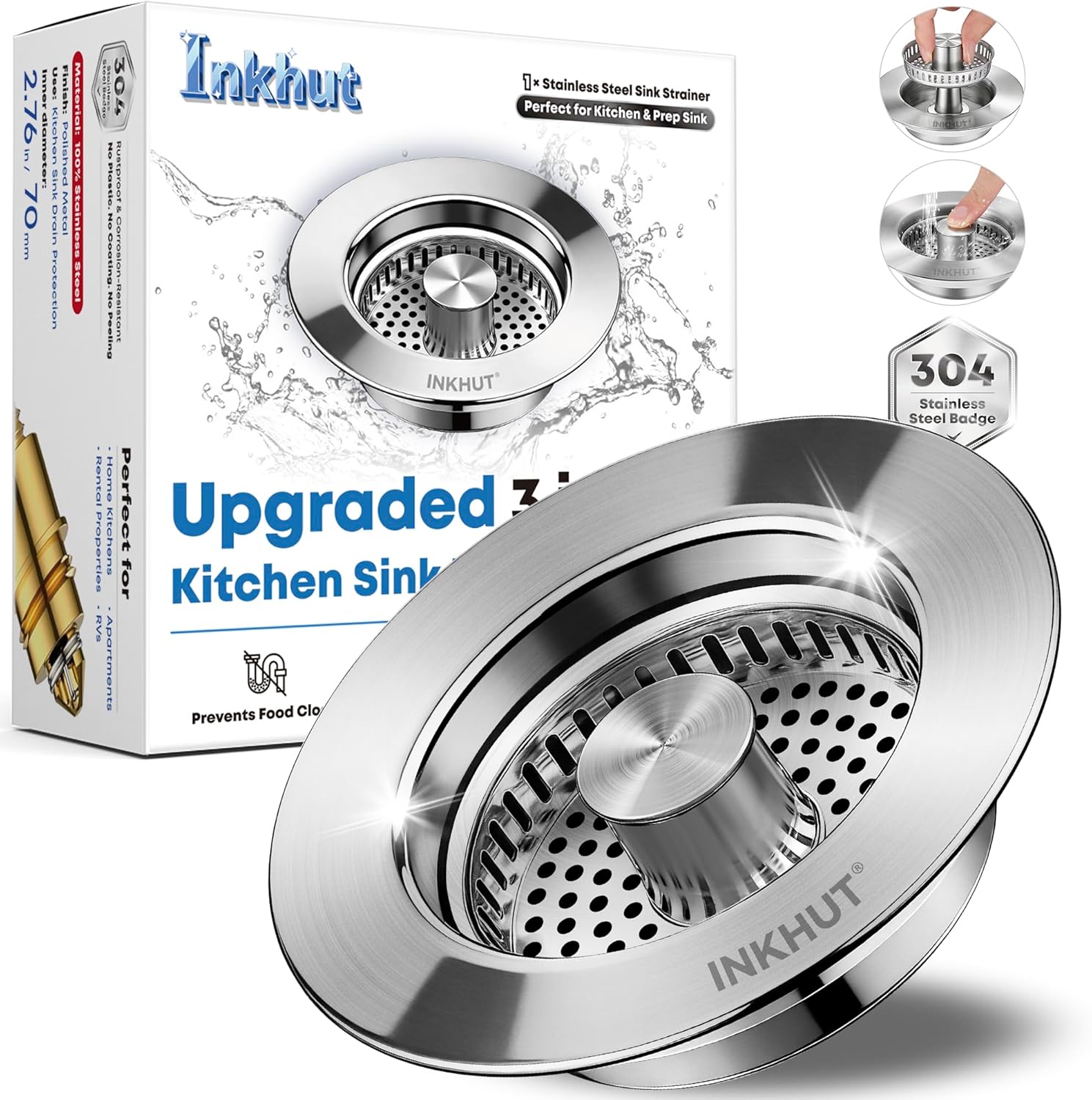
- Inkhut Upgraded 3-in-1 Stainless Steel Kitchen Sink Drain Strainer, Silver — $9.99
- KESOL Rustproof 3-in-1 Stainless Steel Sink Caddy for Sponges, Brush & Cloth — $9.99
- BFONS Silicone Faucet Drip Catcher & Organizer Tray for Kitchen Sink, Grey — $9.99
- POWERSIR Upgraded 3-in-1 Kitchen Sink Drain Strainer Stopper, Brushed SUS 304 Stainless Steel, 1 Pack — $11.99
- Lyxel Fast Drying Diatomite Stone Faucet Mat for Kitchen Sink, Dark Gray 20" x 4" — $14.99
Related reading
Two other pieces on this site cover ground next to this one. Most US kitchen sinks share one drain size, which makes this one of the easier things to replace. And on a related note, a sponge that smells has been sitting in water. Everything else is a detail.
Telling real rust from surface staining
Orange marks that wipe away with a cloth and a little vinegar are transferred iron from steel wool or a cast iron pan, not corrosion of the caddy itself. The caddy is intact underneath.
Rust that has pitted the surface, so it feels rough rather than looking discoloured, is the caddy corroding. At that point the passive layer has failed locally and it will continue, so replacement is the realistic answer.
Where corrosion starts first
Welds and joints are almost always first, because the heat of welding disrupts the protective layer and the geometry traps water. That is why one-piece pressed caddies often outlast fabricated ones.
Contact points where the caddy rests on the sink are second, because water is held by capillary action in the gap. Feet that lift the body clear are worth having for exactly this reason.
What to prioritise
Choose drainage first, grade second, and finish last. Rinse it when you finish washing up, do not store steel wool on it, and a caddy will stay clean for years rather than staining within months.
We ship out of Los Angeles, CA for $5.50, or free above $45, and take unused returns for 30 days. [email protected] if you want to check something first.